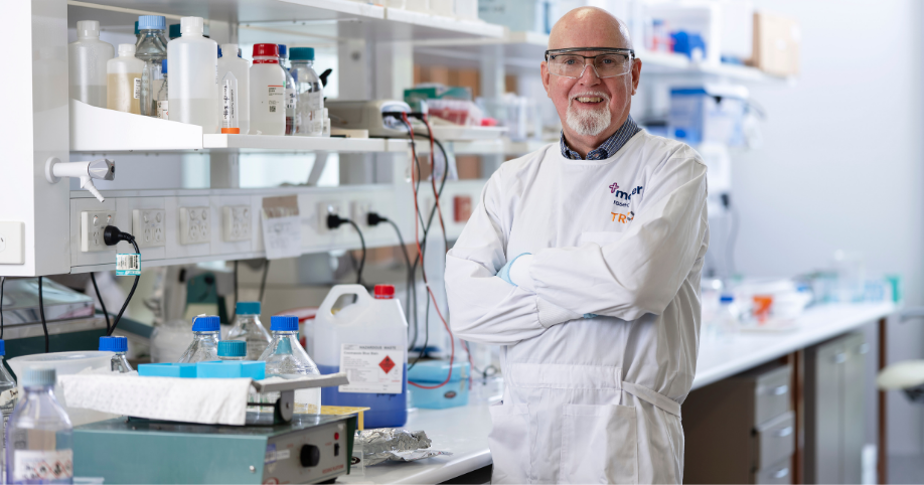
The pilot study, led by Professor John Hooper of Mater Research’s Cancer Biology Research Group, will involve 15 women suffering from the most aggressive types of breast cancer.
“We have uncovered a “bullseye” on the most aggressive tumours—a receptor called CDCP1—and we are developing a world-first approach to strike it,” Professor Hooper said.
“These deadly cancers include the triple-negative, treatment-resistant HER2- positive and metastatic ER-positive subtypes of breast cancer, which are the worst of the worst.”
Triple negative breast cancer (TNBC) is an aggressive type of breast cancer which does not have any of the three receptors commonly found on breast cancer cells, which means regular treatment protocols can be ineffective.
TNBC accounts for about 15 per cent of all new breast cancer cases diagnosed each year in Australia, with around a quarter of all new TNBC cases diagnosed in women under 40.
“It often spreads fast, to places like the brain and lungs, and is resistant to standard therapies like chemotherapy and hormone blockers, and it frequently returns even after patients are seemingly cured,” Professor Hooper said.
“For many women, these diagnoses often mean limited options and poor survival rates.”
Developed over two decades, Professor Hooper’s proposed new breast cancer treatment strategy involves using a PET scan to identify patients whose tumours carry CDCP1, then delivering a cancer-killing drug directly to those cells.
“What we’re doing is injecting the patient with a radioactive tracing agent which is designed to pinpoint the exact location of cancer cells, and we’re looking at how it accumulates in their tumours,” Prof Hooper said.
In preclinical trials, a different radioactive particle to treat the cancer was attached to the tracing agent, to destroy the tumours.
“This could be a game-changer,” Professor Hooper said.
“It’s precision medicine – giving targeted treatment to patients based on their individual needs and sparing them from many unnecessary side effects.
“While there’s still much to learn, it’s possible that the approach could also be used to detect and treat early-stage breast cancers – if that happens, it could possibly even eliminate the need for a mastectomy.”
Working professional Kirsty, 50, was diagnosed with highly aggressive triple-negative breast cancer in August 2025 after a mammogram, biopsy and lumpectomy.
It had been four years between mammograms for the busy mother-of-two, who was otherwise fit and healthy.
“The biopsy showed non-invasive carcinoma (pre-cancerous), but the lumpectomy results showed invasive breast cancer which wasn’t picked up in the original biopsy,” Kirsty said.
“The first thing I thought of was my kids, that was hardest.
“It was very confronting. As a mother, it was my worst nightmare.”
After four rounds of chemotherapy last year, Kirsty underwent a double mastectomy and reconstruction in January at Mater Private Hospital Brisbane.
After the six-hour operation, the pathology results of her breast tissue came back showing three residual carcinoma that had been resistant to the chemotherapy, one invasive that appeared to be aggressive, and two non-invasive.
“It was quite a shock. For me, having a double mastectomy was the right decision. I am very relieved that I did,” Kirsty said.
“Although I feel incredibly grateful that I’m now cancer free, I’m very heartened that more research into these rare and highly aggressive cancers is being conducted, because there are so many lives that it may benefit or save in the future, including mine should the cancer return,” she said.
Breast cancer killed more than 665,000 women worldwide last year, but Professor Hooper says this breakthrough offers hope—not just for breast cancer, but for other cancers where CDCP1 is found, including ovarian and bladder cancer.
“This is about giving women who currently have very few options a fighting chance,” Professor Hooper said.