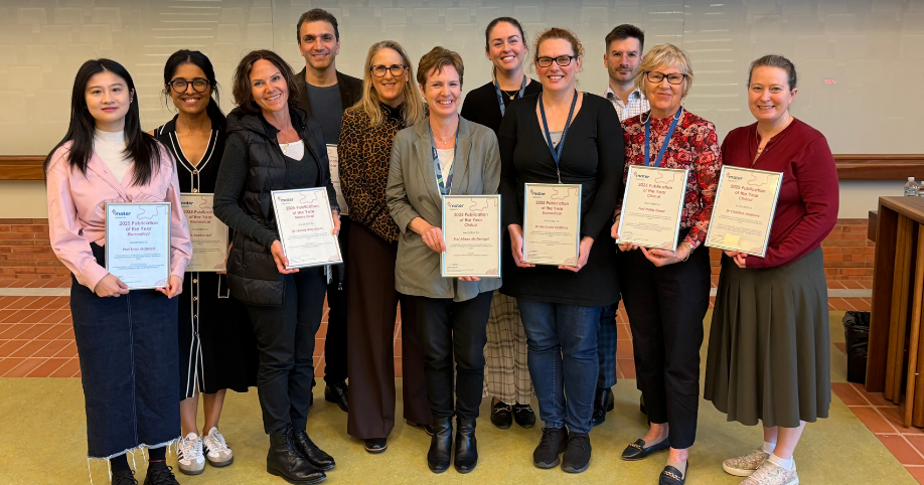
Mater’s 2025 Publication of the Year winners have been announced, recognising diverse biomedical and clinical research projects with the potential to deliver significant benefits for patients and the community.
The awards celebrate outstanding research publications that were published between 1 July 2024 and 31 December 2025. Each paper has advanced critical medical knowledge, delivering tangible real-world impacts and demonstrating scientific excellence.
Research teams receive $3,000 to offset the associated publication and/or research dissemination costs.
Mater Research Executive Director Professor Allison Pettit said the range of research topics exemplified the breadth of Mater Research’s programs.
“From the brain to bones, from pregnancy development to dementia, these projects cover the continuum of human development,” Prof Pettit said.
“Congratulations to all the winners.”
This year’s winners comprised five biomedical and six clinical and health services publications.
The 2025 Mater Publication of the Year Scheme Winners are:
Biomedical
Dr Kylie Alexander and coauthors for A glucocorticoid spike derails muscle repair to heterotopic ossification after spinal cord injury, which was published in Cell Reports Medicine in 2024.
This research investigated complications following spinal cord injuries, specifically how abnormal bone growth (heterotopic ossification) occurs in muscle tissue. The team discovered that a spike in glucocorticoids—steroid hormones related to stress—disrupts normal muscle repair processes, leading to this debilitating condition. Understanding this mechanism opens pathways for targeted interventions to improve patient recovery and mobility.
Other contributing authors were Hsu-Wen Tseng, Hong Wa Lao, Dorothée Girard, Valérie Barbier, Jacobus P J Ungerer, Brett C McWhinney, Selwin G Samuel, Whitney Fleming, Ingrid G Winkler, Marjorie Salga, François Genêt, Sébastien Banzet, Marc Ruitenberg and Jean-Pierre Lévesque.
Dr Michaela Kindlová and coauthors for An allele-resolved nanopore-guided tour of the human placental methylome, which was published in Nature Communication in 2025.
This study used advanced nanopore sequencing technology to map the DNA methylation patterns of the human placenta in unprecedented detail. By distinguishing between maternal and paternal alleles, the research team gained crucial insights into how genes are regulated during pregnancy. These findings provide a foundational resource for understanding placental function and its impact on fetal development and maternal health.
Other contributing authors were Hannah Byrne, Jade Kubler, Sarah Steane, Jessica Whyte, Danielle Borg, Vicki Clifton and Adam Ewing
Dr Rabina Giri and coauthors for Pathogenic OTUD3 Mutations Predispose to Ulcerative Colitis Due to Barrier Dysfunction, which was published in Cellular and Molecular Gastroenterology and Hepatology (CMGH) in 2025.
The research explored the genetic underpinnings of Ulcerative Colitis, a chronic inflammatory bowel disease. The team identified that specific mutations in the OTUD3 gene compromise the protective barrier lining the gut, making individuals more susceptible to the disease. This discovery highlights a significant genetic risk factor and potential new targets for restoring intestinal barrier function in patients. Other contributing authors were Minyi Lee, Graham W Magor, Anne-Sophie Bergot, Yaowu He, Thomas Kryza, Tashbib Khan, Veronika Schreiber, Robert J Gordon, Rachid Zagani, Sumaira Hasnain, Rohan Lourie, Adam Ewing, John Hooper, Ranjeny Thomas, Timothy Florin, Andrew Perkins, Manish Gala and Jakob Begun.
Dr Léanie Kleynhans and coauthors for Human alveolar macrophage function is impaired in tuberculosis contacts with diabetes, which was published in EBioMedicine in 2025.
This paper investigated the dangerous intersection of two major global health challenges: tuberculosis (TB) and diabetes. The study revealed that individuals with diabetes who are exposed to TB have impaired alveolar macrophages—the immune cells in the lungs responsible for fighting off the bacteria. This crucial insight helps explain why patients with diabetes are at a higher risk of developing active TB, paving the way for better clinical management of co-infected individuals.
Other contributing authors were Carine Kunsevi-Kilola, Happy Tshivhula, Tariq Webber, Alana Keyser, Nicole Prins, Candice I Snyders, Ayanda Shabangu, Virginie Rozot, Martin Kidd, Hao Zhang, Hong Cai, Yufeng Wang, Adam Ewing, Stephanus T Malherbe, Abul K Azad, Eusondia Arnett, Blanca I Restrepo, Larry S Schlesinger and Katharina Ronacher.
Professor Brian Gabrielli and coauthors for Aurora B inhibition induces hyper-polyploidy and loss of long-term proliferative potential in RB and p53 defective cells, which was published in Cell Death & Disease in 2025.
This research focused on novel approaches to targeting cancer cells that have lost critical tumour suppressor genes, such as RB and p53. The team discovered that inhibiting the Aurora B enzyme forces these defective cells to undergo abnormal cell division, ultimately stripping them of their ability to continue multiplying. These findings present a promising therapeutic strategy for treating aggressive cancers that are resistant to standard therapies.
Other contributing authors were Shivam Vora, Saptarshi Chatterjee, Ariel Andrew, Ramyashree Prasanna Kumar, Martina Proctor, Zhen Zeng, Rituparna Bhatt, Deborah Nazareth, Madushan Fernando, Mathew J K Jones, Yaowu He, John Hooper, Nigel A J McMillan, Jelena Urosevic, Jamal Saeh, Jon Travers, Daniela Cimini and Jing Chen.
Clinical and Health Services Research
Dr Christine Andrews and coauthors for Conversations About Stillbirth Risk in Routine Antenatal Care: A Qualitative Study Post-Implementation of the Safer Baby Bundle, which was published in BJOG: An International Journal of Obstetrics & Gynaecology in 2025.
This qualitative study evaluated the real-world impact of the Safer Baby Bundle, an initiative designed to reduce stillbirth rates. By examining how healthcare providers discuss stillbirth risks with expectant mothers during routine care, the research highlighted both the successes and the challenges in clinical communication. The findings provide vital feedback for improving antenatal education, ensuring parents receive clear, supportive, and empowering information.
Other contributing authors were Ashley Pade, Fran Boyle, Dan Richard Fernandez, Laura Singline, Ann Lancaster, David Alan Ellwood, Adrienne Gordon and Vicki J Flenady.
Professor Phillip Good and coauthors for Medicinal cannabis for symptom control in advanced cancer: a double-blind, placebo-controlled, randomised clinical trial of 1:1 tetrahydrocannabinol and cannabidiol, which was published in Supportive Care in Cancer in 2025.
This rigorous clinical trial investigated the efficacy of medicinal cannabis in alleviating the heavy symptom burden experienced by patients with advanced cancer. By comparing a balanced THC and CBD formulation against a placebo, the research team gathered vital, high-quality evidence on its role in palliative care. The study aims to guide clinical practice, ensuring cancer patients have access to safe and evidence-based options for improving their quality of life.
Other contributing authors were Janet Hardy, Ristan Greer, Anita Pelecanos, Georgie Huggett, Alison M Kearney and Taylan H Gurgenci.
Dr Hamid Karimi-Rouzbahani and coauthors for Directionality of neural activity in and out of the seizure onset zone in focal epilepsy, which was published in Network Neuroscience in 2025.
This paper explored the complex brain networks involved in focal epilepsy, a condition where seizures originate in a specific area of the brain. The study mapped how neural signals travel into and out of this "seizure onset zone," providing a clearer picture of how abnormal electrical activity spreads. Understanding these communication pathways is critical for developing more precise diagnostic tools and targeted surgical interventions for patients with drug-resistant epilepsy.
This paper was coauthored by Aileen McGonigal.
Professor Aileen McGonigal and coauthors for Symptom network analysis of prefrontal seizures, which was published in Epilepsia in 2025.
This research provided a highly detailed analysis of the clinical symptoms associated with seizures originating in the prefrontal cortex. By mapping how various physical and cognitive symptoms cluster and interact during a seizure, the team created a comprehensive "symptom network." This innovative approach helps clinicians better recognise the often subtle and complex signs of prefrontal epilepsy, leading to faster, more accurate diagnoses and tailored treatment plans.
Other contributing authors were Christophe Gauld, Fabrice Bartolomei and Jean-Arthur Micoulaud-Franchi.
Dr Joshua Flavell and coauthors for Factors associated with true-positive and false-positive diagnoses of behavioural variant frontotemporal dementia in 100 consecutive referrals from specialist physicians, which was published in the European Journal of Neurology in 2025.
This study addressed the diagnostic challenges surrounding behavioural variant frontotemporal dementia (bvFTD), a condition often misdiagnosed due to its varied psychiatric symptoms. By analysing 100 consecutive referrals, the research identified the key clinical factors that lead to correct or incorrect diagnoses of the disease. These insights are essential for refining diagnostic criteria and ensuring patients receive the correct care and support sooner.
Other contributing authors were Emily Ahern, Benignus Logan, Thomas Shaw, Robert Adam, Caitlin McElligott and Peter J Nestor.
Dr Joshua Flavell and coauthors for A preliminary investigation of a Geriatric Depression Scale, Dementia version (GDS-D), which was published in the Journal of Affective Disorders in 2025.
This research focused on improving mental health assessments for older adults living with cognitive impairment. The team investigated a modified version of the Geriatric Depression Scale tailored specifically for individuals with dementia (GDS-D). By validating this adapted tool, the study ensures that depression—a common and debilitating comorbidity in dementia—can be accurately identified and treated, significantly improving patient wellbeing.
Other contributing authors were Kailas Roberts, Philip Morris, Philip Mosley, Emily Ahern, Benignus Logan, Robert Adam, Caitlin McElligott, Thomas Shaw and Peter J Nestor.