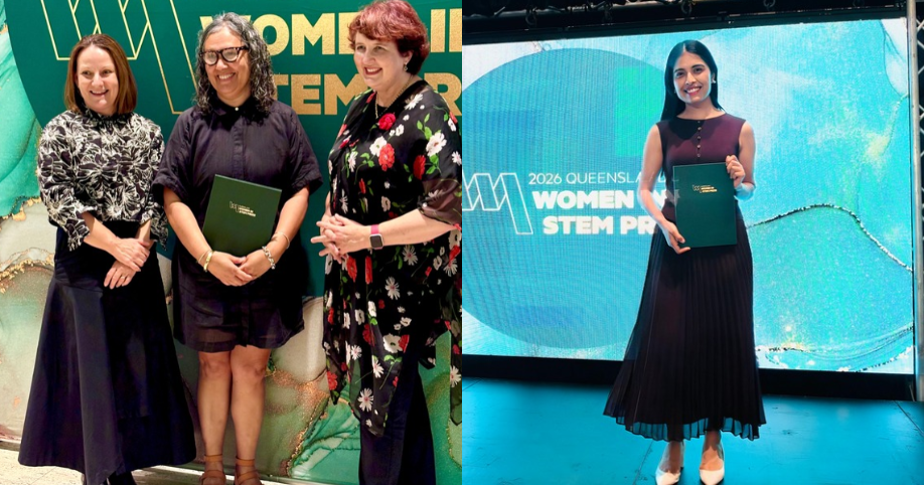
Two outstanding Mater Research women have been celebrated at the 2026 Queensland Women in STEM Prize, reflecting their contributions to biomedical innovation and community-led health research.
Davina Smith was awarded Highly Commended in the First Nations STEM Award, while Dr Rabina Giri was nominated for the prestigious Judges’ Award.
A proud Gooreng Gooreng and South Sea Islander woman, Davina is a Senior Indigenous Research Officer who is transforming how Aboriginal and Torres Strait Islander health research is designed and translated into practice across Queensland.
Her Highly Commended recognition in the First Nations STEM Award highlights her commitment to culturally responsive, community-led research that centres Indigenous knowledge systems.
Davina plays a vital leadership role in the Strong Families Study, a landmark Indigenous-led longitudinal birth cohort study co-designed to support 400 Aboriginal and Torres Strait Islander families from pregnancy through the first five years of their child’s life. Through extensive consultation with more than 10 Queensland communities—including Palm Island, Woorabinda, Townsville and the Darling Downs—she has ensured that local voices and lived experiences directly shape health research priorities and service delivery.
Her leadership at Mater Research, which earned her the Sister Mary Athanasius Reardon Medal in 2024, continues to build a more equitable health future while inspiring a new generation of First Nations women to pursue STEM careers.
Dr Giri is an emerging leader in inflammatory bowel disease (IBD) and microbiome science whose discoveries are already delivering tangible scientific and economic benefits to Queensland. Just two years post-PhD, Dr Giri has authored more than 22 peer-reviewed publications and attracted significant competitive funding. Her growing research leadership has also been recognised through several prestigious awards and fellowships, including the 2026 Reginald Ferguson Research Fellowship.
Her pioneering research identified microbiome-derived molecules capable of suppressing a central inflammatory pathway in IBD, as well as pathogenic OTUD3 genetic variants associated with ulcerative colitis.
Earlier this year, she was awarded the Mater Research Future Leaders Fellowship to investigate the growing incidence of bowel cancer in people under 50 by examining the relationship between diet, gut bacteria and intestinal barrier health. The research seeks to identify early microbial warning signs and lay the foundations for personalised prevention strategies that could help stop bowel cancer before it develops.
Mater Research Executive Director Professor Allison Pettit said that both researchers exemplify the innovation, leadership and measurable impact the prize seeks to recognise.
“Beyond their research milestones, both Davina and Rabina share a dedication to mentorship,” Prof Pettit said.
“Whether providing cultural mentorship to strengthen research safety or supervising higher-degree students to build Queensland's future scientific workforce, their recognition at the 2026 Queensland Women in STEM Prize is a testament to their vital roles as inspiring STEM leaders for women and girls.”