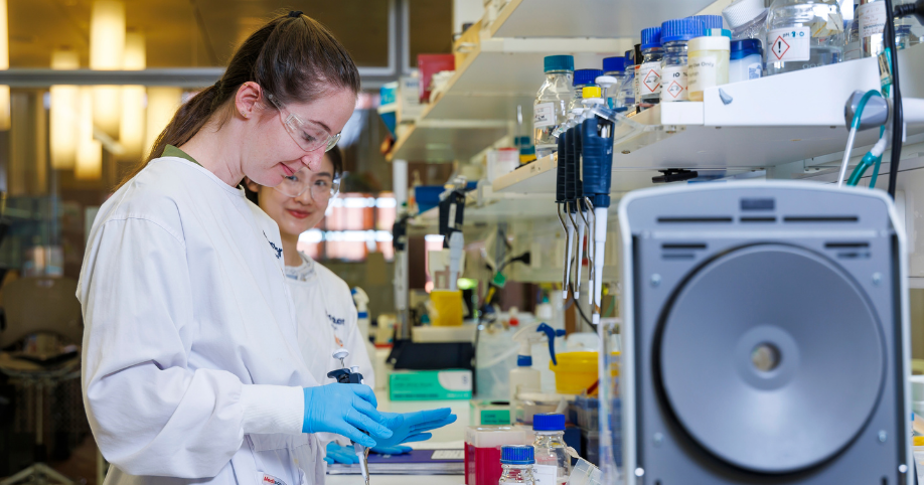
For PhD student Anastasia Gandini, the path to a career in medical research was fuelled by a lifelong love of learning and a deep commitment to improving patient outcomes.
Through her PhD at Mater Research and The University of Queensland (UQ), Anastasia is investigating how the immune system responds to ovarian cancer when treated with novel targeted therapies.
With applications for Higher Degree Research study at UQ now open, learn more about why Anastasia chose to pursue a PhD through Mater Research and UQ, and how the community at Mater Research makes all the difference for an international student.
After completing a Master of Science in Medicine – Immunology at the University of Witwatersrand in South Africa, Anastasia joined Mater Research as an international PhD student in 2024.
Anastasia has always had a love of learning.
“A PhD and an academic career are natural progressions of this,” she said.
“I thoroughly enjoyed studying human biology in high school and when I expanded this knowledge during my undergrad, I became fascinated by the intricacies of the immune system and their interplay with cancer cells.”
This interest led her to tackle one of the most challenging areas of oncology - ovarian cancer.
Anastasia’s thesis is exploring the immune responses in ovarian cancer when treated with a novel targeted therapy. Her work aims to bridge the gap between complex biological mechanics and meaningful clinical outcomes, with patients at the forefront of her research goals.
“This played a major part in my decision to pursue my PhD with Mater Research because of the value it places on patient-centred research and consumer advocacy,” Anastasia said.
As an international student, Anastasia has found the culture at Mater Research has been integral to her experience.
“My favourite thing about Mater Research is the people,” she said.
“There is an incredible community at Mater Research, particularly within the student cohort. This is incredibly important for me both as a PhD student and an international student.”
She also credits her supervisors for cultivating an environment where she can thrive.
"I’ve been very lucky to have several mentors in varying capacities at Mater. A key person is my primary supervisor, Professor Brian Gabrielli,” she said.
“He is terrifically skilled at understanding what each of his students uniquely needs from their supervisor, and as a result, he cultivates a supportive environment in which to mentor his students."
As for life after she completes her PhD, Anastasia is not looking to an endpoint other than staying true to her core mission and journey, and hopes that it includes passion-driven, patient-focused research.