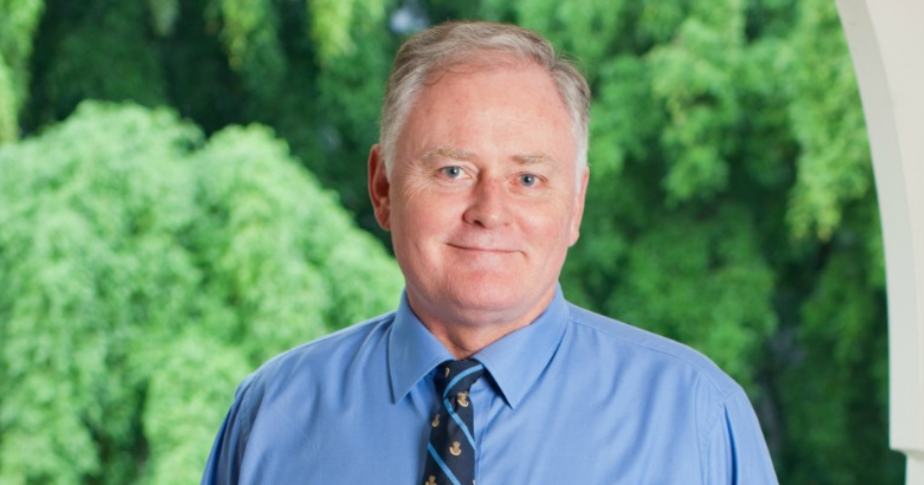
A Mater clinician researcher who has made outstanding and sustained contributions to medical research, clinical care, education and leadership in the field of endocrinology—particularly in diabetes in pregnancy—was recognised in this year’s King’s Birthday Honours as an Officer of the Order of Australia (AO).
Congratulations to Emeritus Professor David McIntyre AO, who was recognised for his distinguished service to medicine as a clinician, to medical research and education, to policy development, and to allied health administration.
Since beginning his career at Mater in 1982, E/Prof McIntyre has dedicated more than four decades to improving the health outcomes of women and babies affected by diabetes and other endocrine disorders.
He transformed care by establishing a new sub-specialty service in Diabetes and Endocrinology at Mater, and in 1998, he founded the Queensland Diabetes and Endocrine Centre (QDEC)—Queensland’s first tertiary centre for comprehensive diabetes care—now caring for approximately 1,500 Queenslanders annually.
He served as Director of Obstetric Medicine at Mater Mothers’ Hospital from 1999 to 2022 where he established and continues to lead the Diabetes in Pregnancy Clinic, working closely with Mater’s Maternal Fetal Medicine Centre to provide integrated, multidisciplinary care for women with complex pregnancies, comprising around 16 per cent of Mater’s 11,000 births each year.
His leadership has extended well beyond Mater. Until recently, E/Prof McIntyre served as Conjoint Professor of Medicine and Head of the Mater Clinical Unit at The University of Queensland (UQ). In 2023, he was conferred the title of Emeritus Professor by UQ in recognition of his outstanding service. That same year, he received the Lifetime Achievement Award from the Australian Diabetes Society—an honour that reflects his lifelong dedication to improving care for women and families affected by diabetes.
He has built enduring collaborations with Mater Research and other UQ institutes, driving innovation and excellence in clinical care and research. This includes a lead role in establishing the Diabetes in pregnancy registry in rural and remote Northern Territory and Western Australia and catalysing the community-led Aboriginal and Torres Strait Islander Diabetes Across the Lifecourse partnership. This initiative is transforming care in these regions and breaking the intergenerational burden of disease.
As a clinician-scientist, E/Prof McIntyre has published more than 250 peer-reviewed papers, amassing more than 25,000 citations, primarily in the field of medical complications of pregnancy. His research spans basic cell biology, clinical trials and large-scale epidemiological studies which has shaped global understanding of the effects of diabetes, obesity and hypertension during pregnancy. His work has led to improved diagnostic criteria, treatment protocols, and long-term follow-up strategies for mothers and their children.
Among his most significant achievements is the introduction of the Dose Adjustment for Normal Eating (DAFNE) program to Australia in 2005. This structured education model empowers people with Type 1 diabetes to manage their condition through intensive insulin therapy tailored to their lifestyle. More than 2,000 Australians have completed the program, which is now embedded in national guidelines and offered in more than 20 centres across Australia and New Zealand.
E/Prof McIntyre has also played a pivotal role in the development of gestational diabetes mellitus (GDM) guidelines. He was a founding member of the International Association of Diabetes in Pregnancy Study Groups (IADPSG) and chaired the consensus conference that established global diagnostic criteria for GDM. His leadership extended to the Statewide Clinical Diabetes Network, where he chaired the GDM workgroup and led the development of Queensland’s clinical guidelines. He co-led the development of the Queensland Clinical Guidelines for GDM in 2015 and their revision in 2021 and was lead author on Mater’s local GDM guidelines.
His work has directly led to earlier and more accurate diagnosis of GDM, allowing timely intervention and reduced rates of maternal and neonatal complications, including pre-eclampsia, macrosomia, and neonatal hypoglycaemia. GDM is now recognised as a key predictor of future Type 2 diabetes in both mother and child.
A standout example of his innovation is the Mater-based redesign of GDM care—a digitally supported, woman-centred model that delivered improved outcomes for culturally diverse populations while achieving significant cost savings. Data from the pilot program showed that the reduction in face-to-face visits saved the 1,200 women in the intervention group a combined $679,872, accounting for lost wages, childcare and travel expenses. Clinical outcomes confirmed that the novel model of care was equivalent to traditional care.
E/Prof McIntyre has also pioneered Mater’s digital eConsultant program to support GPs seeking timely access to specialist medicine advice. Supported by the Queensland Government to improve access to specialist care in regional and remote parts of the state, the Mater Queensland eConsultant program is expanding to further reduce the need for face-to-face outpatient consultations and to enhance patient care for all Queenslanders.
Beyond his own research, E/Prof McIntyre has played a pivotal role in fostering collaboration and innovation. From 2011 to 2016, he led the Mother and Baby Program at Mater Research, strengthening internal and external partnerships. He also headed the Mothers, Babies and Early Development theme of the Diamantina Health Partners, which evolved into the Brisbane wide collaborative network now known as Health Translation Queensland. Until 2019, he served as UQ’s representative on the Mater Research Board, further demonstrating his commitment to bridging research and clinical excellence.
His influence extends globally through his work with leading organisations such as the Australasian Diabetes in Pregnancy Society, American Diabetes Association, Diabetes in Pregnancy Study Group of the European Association for the Study of Diabetes, FIGO (The International Federation of Gynaecology and Obstetrics) and the International Association of Diabetes in Pregnancy Study Groups. He has contributed to clinical guidelines and care models through the NHMRC Global Alliance for Chronic Diseases and internationally, including in Denmark, where he serves as an Honorary Skou Professor and Danish Diabetes Academy Visiting Professor at Aarhus University, contributing to national GDM guidelines and supervising PhD students.
E/Prof McIntyre is also a passionate mentor. More than 40 trainees have benefited from his guidance, many of whom now hold senior clinical and academic roles. His legacy continues through the work of clinicians and researchers at Mater, such as Associate Professor Josephine Laurie, Dr Janelle Nisbet and Associate Professor Shelley Wilkinson, who are advancing the field of diabetes in pregnancy with the same commitment and innovation he has modelled.
Throughout his distinguished career, E/Prof McIntyre has demonstrated unwavering commitment to clinical excellence, research innovation and the mentorship of future leaders. His legacy lives on in the improved health outcomes for thousands of women and children, the clinicians he has guided and the enduring systems of care he has helped shape.
His contributions to the broader medical and research community have been profound and far-reaching. The lives he has touched and the advancements he has championed will continue to influence generations to come, and Mater is exceptionally proud to be the institution where his defining achievements took place.